[AI] God of Thunder for 32X
- physical : no
- rom : yes
- licensing : unlicensed
- code : godofthunderfor32xbyharoldook
- Date(s) : 2026
- Tag(s) : #2D, #Homebrew, #Pixel Art, #sega-32x, #Top-Down, #Generative AI used
- Platform(s) : MD
- By(s) : Haroldo OK!
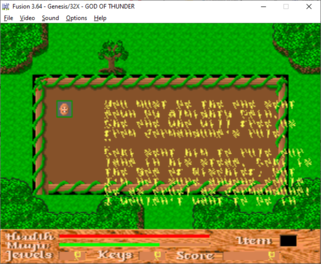
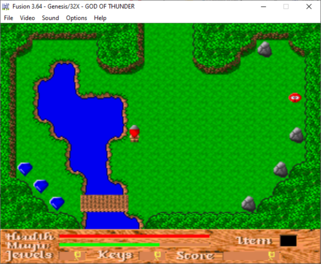
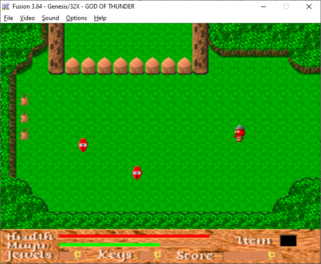
A port of the 1993 DOS game God of Thunder (Ron Davis / Adept Software) to the Sega 32X, built from the public-domain source release plus the original retail resource file.
Github repo: https://github.com/haroldo-ok/god-of-thunder-32X
Original source: https://github.com/SheridanR/god-of-thunder
The compiled ROM lives at rom/got32x.32x — 2 MB, a self-contained Sega 32X cartridge image with every game asset embedded. No external data file is needed.
Controls
D-pad
Move Thor
Arrow keys
B
Swing hammer
Ctrl / Space
C
Use selected magic
Alt
A
Cycle inventory item
Tab
Start
Options menu
Esc
Action
What had to be solved
1. The resource format was undocumented
res_read() — the function that reads every asset — is commented out in the source release, and the resource manager it depended on (res_man.h) was a third-party library that was never published. The 740 KB GOTRES.DAT was effectively an opaque blob.
Reverse-engineering it yielded:
a 256-entry directory, XOR-encrypted with a positional key: byte i is XORed with (0x80 + i) & 0xFF;
23-byte records of char name[9]; u32 offset; u32 size; u32 origSize; u16 key;
payloads compressed with an LZSS variant that uses relative back- references (dest - offset), not the usual ring buffer. This detail matters: every ring-buffer LZSS dialect decodes the first few hundred bytes correctly and then diverges, which is exactly the sort of bug that looks like a rendering problem later. ScummVM's GOT engine was used to confirm the exact dialect.
All 177 resources now decode losslessly.
2. Two different pixel layouts in the same file
This one caused a visible bug mid-port. The file contains both:
Background tiles / pictures (262-byte blocks: a 6-byte header then pixels) stored in VGA Mode X plane order — plane p holds every 4th pixel starting at column p. These must be de-planed.
Actor sprite frames (bare 256-byte blocks, 16 per actor) stored linearly. The original blits them with a straight 256-byte copy.
De-planing the actor frames produced correct-looking noise — plausible pixel values in the wrong places, so Thor rendered as static. The fix was to confirm against the original make_actor_surface()/xput paths, which copy sprite bytes through untouched.
3. Mode X → chunky framebuffer
The DOS game drove VGA Mode X: four planes, writes gated through the Sequencer map-mask register, four hardware pages, and sprites pre-shifted into four separate plane alignments with nibble-oriented masks (make_mask() in 1_IMAGE.C). That machinery is why the game had a hard cap on actor frames — it ran out of VGA memory.
The 32X provides a linear 8-bit chunky framebuffer, so all of it collapses into ordinary memory copies. There is no frame budget and no per-screen upload. Assets are de-planed once at build time.
4. Screen height: 240 → 224
The DOS layout was 192 lines of play area plus a 48-line status panel, held in place by the VGA split-screen (CRTC line-compare). NTSC 32X only displays 224 lines (240-line mode is PAL-only).
Cropping the play area was not an option — the whole engine is built around a 12×20 grid of 16px tiles. Instead the play area stays pixel-exact at 320×192 and the panel is compressed 48→32 lines. That compression is not a blur: the panel art is drawn in 4-line bands, so dropping one row in four reproduces it faithfully at ¾ height, with bar and text coordinates scaled to match.
5. 16-bit int → 32-bit int
Turbo C's int was 16-bit. Every structure that is read directly out of GOTRES.DAT (LEVEL, ACTOR_NFO, …) therefore uses explicit s16/u16 in this port. The on-disc layout is load-bearing, so it is pinned with compile-time assertions in src/got.h:
GOT_ASSERT(level_size, sizeof(LEVEL) == 512); GOT_ASSERT(level_sobj, __builtin_offsetof(LEVEL, static_obj) == 322);
The comments in the original 1_DEFINE.H were stale — they claimed static_obj sat at offset 302, while the code that copies it uses 322. The assertions encode the layout the code actually relies on.
6. Tile collision has inverted polarity
The engine classifies background tiles by index, and the rule is the opposite of what intuition suggests:
#define TILE_SOLID 80 #define TILE_FLY 140 / icon < TILE_FLY => solid, blocks walking / #define TILE_SPECIAL 200 / icon > TILE_SPECIAL => scripted tile /
Low indices are the solid scenery (trees, water, rock) and high indices are open ground. Screen 23's grass is tile 176.
An early version of this port guessed the opposite (140 <= icon < 200 blocks), which marked the player's own spawn tile solid and walled Thor in from the first frame — he would turn to face each direction but never take a step. The fix was to port check_move0() faithfully, including its four-probe foot box:
x1 = x + 1 y1 = y + 8 (feet, not centre - so Thor's head can x2 = x + 12 y2 = y + 15 overlap scenery while he walks past it)
The two regression tests player can move on both axes and player can walk out and back were added specifically for this, and were confirmed to fail against the buggy build.
7. Direction codes are load-bearing
The engine's direction encoding is 0=UP, 1=DOWN, 2=LEFT, 3=RIGHT (movement_zero() / movement_two() in 1_MOVPAT.C), and the same value indexes pic[dir][frame]. An early version of this port used 0=DOWN 1=UP 2=RIGHT 3=LEFT — both axes inverted — which made Thor face one way and walk the other, because the facing came from the sprite table while the displacement came from the key handler.
They are now named constants (DIR_UP …) rather than bare literals.
8. The pad reader must handle the full TH handshake
The Genesis 3/6-button protocol delivers the D-pad, A/Start, and the 6-button extras on different TH phases. A hand-rolled reader here silently dropped the B button, so the hammer never fired. It has been replaced with Chilly Willy's / d32xr's proven get_pad sequence, which returns 0 0 0 1 M X Y Z S A C B R L D U (and 0xF000 for an empty port).
9. Most "scenery" is actually an actor with a func_num
This was the biggest missing piece. Crystal balls, money gates, pushable blocks, boulders, barrels, signs, peasants, merchants, hags — and the trees — are not background tiles. They are entries in scrn.actor_type[], i.e. actors, distinguished by a non-zero func_num that indexes special_movement_func[]:
pushable block
angle block
crystal ball, runs a script
peg switches
boulder roll
roll on one axis
villagers, signs, trees
walk-through decoy
func_num behaviour
1 BLOCK1, MOVEROCK
2 REDANGEL, GRNANGEL
3 GLOBE
4, 7 SWITCH, GGLOBE
5 BOULDER
8, 9 HBARREL, VBARREL
10 MAN1, MERCH, KID1, GIRL1, HAG1/2, WOM1/2, SIGN1..4, TR-UL/UR/LL/LR
255 FAKEBUSH
check_move0() dispatches to the handler on contact; a handler returning 0 blocks the move. Without that dispatch every one of these was walked straight through, which is exactly the reported symptom.
Note func_num lives at offset 32 of ACTOR_NFO (after the 9-byte name). Reading it from the wrong offset yields plausible-looking garbage (109, 114, …) rather than the 1–10 range, so the offsets are now pinned with static assertions alongside solid, type and size_x/y.
10. Doors, gates and caves are special tiles
Tiles above TILE_SPECIAL (200) run special_tile_thor():
locked door — consumes a key
ending bridge
always solid
one-way tiles (passable in a single direction)
money gate, 10 jewels
money gate, 100 jewels
end-of-level trigger
teleport pads (solid to Thor)
holes and cave mouths — jump to another screen
tile
201
202
203, 204, 212, 213
205–208
209
210
211
214–217
218–229
The cave/hole handler only fires when Thor's centre is on the tile, and it defers the actual screen change to the main loop via a warp_pending flag, mirroring the original. Opening a door mutates the tile grid, so it also invalidates the cached background.
11. LEVEL records contain little-endian 16-bit fields
static_x[30] / static_y[30] are int arrays written by Turbo C on x86, so they are little-endian. The SH2 is big-endian and this port maps the C struct straight onto the resource bytes, so an x of 2 read back as 512 and every gem, potion and key was drawn far outside the play area — invisible, and unreachable by the pickup test.
tools/mkassets.py now byte-swaps those halfwords when packing SDAT. This is the same class of bug as the tile/sprite layout mismatch: the data is fine, the interpretation has to match the machine.
12. Palette depth
PALETTE stores 8-bit components, but the VGA DAC only accepted 6 bits, so the original shifted everything right by two before programming it. Missing this produces a washed-out, wrongly-hued image. The port applies the same >> 2 and then packs to the 32X's RGB555 CRAM.
Architecture
src/crt0.s SH-2 boot, ROM header, exception vectors (from d32xr) src/mars_hw.c 32X VDP: framebuffer, line table, CRAM, page flipping src/gfx.c chunky-pixel primitives, font, palette/fades, compositor src/res.c ROM-embedded resource archive, read in place src/level.c screen loading, tile rendering, dirty-screen tracking src/actors.c actor loading, frame binding, drawing src/game.c state, movement/collision, main loop src/panel.c status panel (48→32 line adaptation) src/input.c Genesis pad → engine buttons src/sound.c STUB — see below src-md/md_main.s 68000 side: hardware init, pad polling, SH-2 handshake tools/mkassets.py GOTRES.DAT → linear, ROM-embeddable archive tools/mkrom.py pad to cartridge size, fix header checksum tests/runner.c headless libretro harness with scripted input tests/run_tests.py point-to-point test suite
Memory. The 32X has 256 KB of SDRAM. Assets stay in ROM and are read in place — the SH-2 can execute and read straight out of cartridge space — so the 1.3 MB of converted assets cost no RAM. Only mutable state is in SDRAM: three page buffers (~138 KB) plus game state and a small dirty-screen cache.
68000 ↔ SH-2. The 68000 samples both pads every vblank and publishes them to the SH-2 through the COMM mailbox (COMM8/COMM10), with a frame counter in COMM12. No handshake is needed on the read path.
Enemy AI, damage and dialogue
Movement. src/move.c ports move_actor() (the speed_count scheduler), check_move2() (enemy collision against scenery, special tiles, other actors and Thor) and the movement patterns episode 1 actually uses:
stand and animate
villagers, signs, trees
walk until blocked, turn randomly
track Thor
as 3, with pauses
straight runs of random length
vertical patrol
diagonal drift
fully static
pattern examples
1
3 ARCHER, BEETLE, SKUNK
4 BRUTUS, ELF, WOODY
7 BOINGY
9 / 37 EAGLE, rats
10 SPIDER
11 BAT
15 BOULDER, FAKEBUSH
29 pass_value YELGAURD
Walking into Thor calls thor_damaged(), which is how enemies hurt the player; that path runs inside check_move2() rather than in the player's own collision code.
Damage. The hammer now deals hammer->strength (10/13/17 by armour) instead of a hardcoded nominal value, matching actor_damaged(act, actr->strength) in check_move1(). A starting hammer one-shots a 10-health BOINGY, as in the original.
Dialogue. src/script.c implements the SPEAK interpreter. Scripts are plain text inside SPEAKn, keyed by |<level*1000 + actor_num> and terminated by |STOP. Implemented commands: SAY and quoted text, PAUSE, SOUND, ADDJEWELS/HEALTH/MAGIC/KEYS/SCORE, SETFLAG, PLACETILE, VISIBLE, END. Control flow (IF/GOTO/GOSUB/FOR, variables and ASK menus) is parsed and skipped rather than executed.
That split is deliberate and it is why some crystal balls talk and others act: a ball whose script is a SAY block opens a dialogue panel, while one that calls PLACETILE/SETFLAG changes the world instead. The same mechanism drives villagers and signs (func_num 10), whose portraits come from FACEn via the leading digits of the actor's name.
Performance
The first playable build ran at roughly 6 logic frames per second. It is now 30 fps (vsync-locked half-rate). The wins, in order of impact:
Cache the background. level_build_screen() was re-drawing all 240 tiles — each twice, base + icon — plus a 61 KB page clear, every frame: ~123 K byte-writes before a single sprite was touched. The tile grid only changes on a screen transition or place_tile(), so it is now composited once into a cache page and restored with one linear copy, with an explicit invalidation hook.
Hoist clipping out of the blit loops. gfx_blit/gfx_blit_masked tested dx < 0 || dx >= SCREEN_W for every pixel. Clipping is now resolved once into adjusted origins and extents before the loops run, leaving only the transparency test in the masked inner loop.
Shifts instead of multiplies. SCREEN_W is 320 = 256 + 64, so y 320 is (y << 8) + (y << 6). That is the ROW() macro, used by every blit, fill, and the compositor. Tile coordinates use x << 4 / >> 4 rather than 16 / / 16, and damage scaling uses << 1 / >> 1.
Long-word copies. 16×16 tiles blit as 4 u32 stores per row; the compositor moves the play area and panel a long at a time.
Cheap early-outs first. Actor collision keeps the original's |dx| > 16 / |dy| > 16 rejects, so most actors cost two compares.
Build flags now follow d32xr's release profile: -O2 -funroll-loops -fno-align-loops -fno-align-jumps -fno-align-labels -fno-common. -O2 rather than -Os because the blit loops benefit from unrolling more than a 2 MB cartridge benefits from a few KB saved.
Audio — stubbed, PWM to follow
As requested, sound and music are stubbed for now. Every call in src/sound.c is a no-op and the game runs silently at full speed.
The original audio was a licensed library that was never open-sourced, so only the data survives — and all of it is already embedded in the ROM: SONG1-4, SONG21-25, SONG31-36, OPENSONG, WINSONG, BOSSSONG, DIGSOUND (59 KB of digitised effects) and PCSOUNDS.
The PWM implementation slots in behind the existing entry points (snd_init, snd_play, music_play, snd_update) without touching the rest of the engine. The intended shape: set MARS_PWM_CYCLE from the sample rate, run the mixer on the slave SH-2 (currently idle in secondary() in src/main.c), and feed a ring buffer from DIGSOUND.
Tests
make test runs the ROM inside PicoDrive and asserts on what is actually rendered and how the game responds to input. 25/25 pass.
PASS rom/header is a valid Sega 32X image PASS rom/game assets embedded in ROM PASS boot/emulator receives video frames PASS boot/screen is NOT black PASS boot/screen is NOT a flat colour PASS boot/first picture appears promptly PASS render/never goes black over 1000 frames PASS render/status panel is drawn PASS render/play area is fully drawn PASS input/directions change the scene PASS input/player translates across the screen PASS input/player can move on both axes (not walled in) PASS input/player can walk out and back PASS input/direction matches movement (not mirrored) PASS input/hammer fires and returns PASS input/player collides with actors PASS world/pickups are spawned PASS world/enemies move on their own PASS world/enemies take hammer damage PASS world/crystal ball opens a dialogue PASS world/special actors are solid PASS world/screen transitions work PASS world/objects can be picked up PASS input/action buttons are handled safely PASS stability/20s scripted session stays healthy
The black-screen guarantee
Four independent checks make a black screen impossible to ship silently:
screen is NOT black — ≥ 50 % of pixels must be lit (currently 99.8 %).
screen is NOT a flat colour — ≥ 8 distinct colours, so a solid fill cannot pass the first check. Currently 75.
never goes black over 1000 frames — the play area is re-measured at frames 60/180/400/700/1000; each must stay ≥ 50 % lit and non-flat. Currently 100 % lit throughout.
20s scripted session — 1200 frames with scripted movement and button input, re-checked at the end.
The panel and play area are measured separately, so a correct HUD cannot mask a blank world (or vice versa).
Proving it is playable, not just a picture
A static screenshot would pass every check above, so interactivity is tested directly. tests/runner.c supports scripted input (--press FRAME:LEN:BUTTON) and frame dumps.
The strongest checks measure Thor's displacement, restricted to the horizontal corridor he occupies — an important detail, because this screen has a roaming enemy, and an earlier version of the test counted changed pixels anywhere on screen and so passed while Thor was completely stuck.
player translates across the screen — holds right and requires the changed region to span ≥ 30 px (a sprite animating in place spans ~16). Measured: 136 px.
player can move on both axes — sweeps right/up/down independently. Measured: 47 / 50 / 50 px.
player can walk out and back — walks right into open ground, then back left, proving reversal works once clear of the tree beside the spawn.
before after
Spawn point, and after walking right + down.
Known gaps
Honest status — the foundation is complete and playable, these are not done:
Audio is stubbed (deliberate; PWM planned).
Enemy AI — the common patterns are ported (see above), but the boss behaviours (1_BOSS*.C) and the more exotic patterns (tornadoes, spinning balls, guns, acid drops) fall back to "animate in place".
Enemy projectiles — shot_pattern_func[] is not wired up, so shooters do not fire.
Diagonal wall-sliding — the original nudges Thor around corners (check_thor_move's per-direction retries); this port resolves the two axes independently, which slides along walls but does not corner-correct.
Magic items (tornado, lightning, shield, hourglass) are not wired up.
Script control flow — IF/GOTO/GOSUB/FOR, variables and ASK menus are skipped, so the shopkeeper scripts show their opening text but cannot complete a transaction.
Pushable blocks move, but boulders (func 5) and the angle blocks (func 2) are currently just solid rather than fully simulated.
Screen transitions jump directly rather than scrolling.
Bosses, dialogue and scripting (1_SCRIPT.C, 1_DIALOG.C) are not wired up.
Save/load to SRAM is not implemented.
Episodes 2 and 3 ship in the ROM (SDAT2/3, BPICS2/3) but only episode 1 is selectable.
Credits
God of Thunder by Ron Davis, source released to the public domain (2020).
crt0.s, the linker script and the 32X hardware reference come from d32xr (Victor Luchits) and Chilly Willy's 32X devkit.
The LZSS dialect and several structure layouts were cross-checked against ScummVM's GOT engine.
Game assets remain the property of their original author and are not covered by the source code's public-domain release.
Data retrieved from haroldo-ok.itch.io
God of Thunder for 32X by haroldo-ok
- title : God of Thunder for 32X by haroldo-ok
- status : Released
- tags : 2D,
Homebrew,
Pixel Art,
sega-32x,
Top-Down
- ai : AI Assisted, Code
- last updated : 2026
- by : haroldo-ok
- code : godofthunderfor32xbyharoldook
Screenshots