[AI] XQuest for 32X
- physical : no
- rom : yes
- licensing : unlicensed
- code : xquestfor32xbyharoldook
- Date(s) : 2026
- Tag(s) : #2D, #Arena Shooter, #Homebrew, #Pixel Art, #sega-32x, #Shoot 'Em Up, #Generative AI used
- Platform(s) : MD
- By(s) : Haroldo OK!
Data retrieved from haroldo-ok.itch.io
XQuest for 32X by haroldo-ok
- title : XQuest for 32X by haroldo-ok
- status : Released
- tags : 2D,
Arena Shooter,
Homebrew,
Pixel Art,
sega-32x,
Shoot 'Em Up
- ai : AI Assisted, Code
- last updated : 2026
- by : haroldo-ok
- code : xquestfor32xbyharoldook
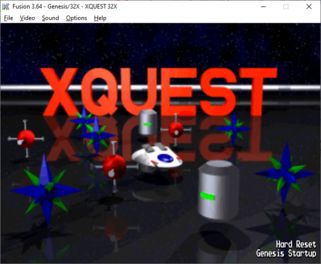
XQuest 32X
A Sega 32X port of XQuest (the classic MS-DOS arcade game by Mark Mackey, 1994-1996 — "Get gems! Avoid mines! Blow lots of things to pieces!").
The original game was written in Turbo Pascal + x86 assembly using Mode X VGA (392x320 logical page, hardware scrolling, split-screen status bar). This port re-implements the gameplay in C for the 32X's SH2 CPUs, and converts all the original data files (sprites, fonts, palettes, enemy stats, level tables, digitized sounds) at build time.
Github Repo: https://github.com/haroldo-ok/xquest-32x
Original source: https://www.dosgamesarchive.com/file/xquest/xquest_13_src
The ROM
xquest32x.32x <- ready-to-run ROM (also in build/xquest32x.32x)
Runs in PicoDrive, Ares, BlastEm-mars, Gens/GS, Fusion, or on real hardware via a flash cart. 384 KB, NTSC/PAL auto.
Controls
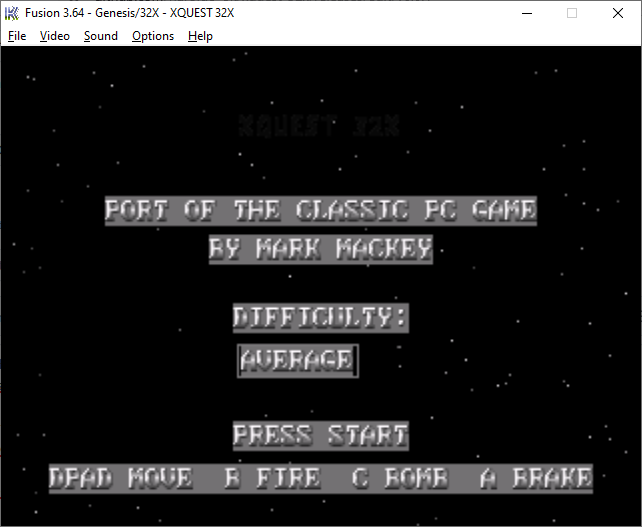
D-Pad
thrust (inertial, with cruise-speed cap and gentle auto-coast when released)
B
fire - shots leave at full muzzle speed in the facing direction, plus the ship's momentum (hold with Rapid Fire powerup for autofire)
C
smart bomb
A
brake
START
start game / pause
Action
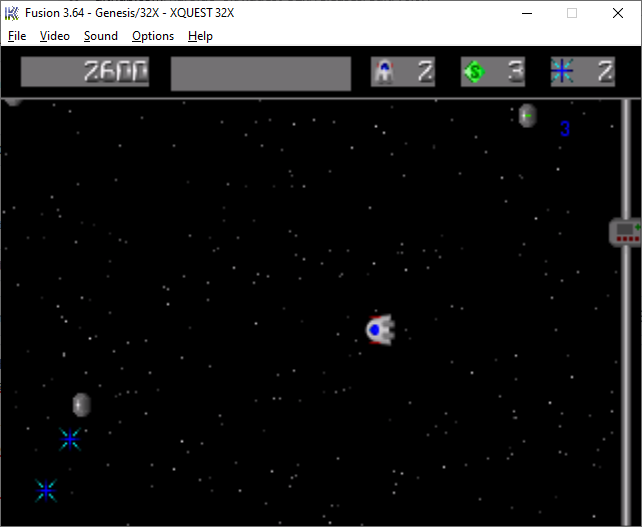
Gameplay: collect all the crystals, avoid the mines, then escape through the gate at the top of the arena. Enemies pour in through the inlets on the left/right walls. Touching a wall on AVERAGE difficulty or above is fatal; supercrystals grant powerups (Shield, Aimed / Rapid / Multi / Ass / Heavy Fire, Bounce, mine-sweep, gate-freeze).
Architecture
src/ m68k_crt0.s 68000 ROM header + Mars vector table (Chilly Willy's 32X startup code) m68k_crt1.s 68000-side helper loop (pad reading, vblank counter) sh2_crt0.s SH2 master/slave startup + Mars module header mars.ld linker script (ROM @ 0x02000000, SDRAM @ 0x06000000) hw32x.c/h 32X VDP (8bpp packed-pixel mode), CRAM, pad, vblank render.c/h software renderer: 392x320 back buffer -> 320x224 FB, sprites, masks, both original fonts, status bar sound.c/h IRQ-driven PWM audio @ 11 kHz on the slave SH2: the PWM timer interrupt mixes up to 4 voices of the original digitized sound effects into the mono FIFO game.c the game: faithful C translation of xquest.pas logic (enemy AI incl. curves/zoom/repulse/tribble/cluster, missiles, powerups, gate, scrolling, levels 1-50, difficulty levels, game-clocked attractor mode) tools/ convert_assets.py converts xquest.gfx/.enm/.fnt/.snd/palette.inc/ title.pbm + tables parsed from xqvars.pas into C fix_checksum.py Genesis header checksum fixer assets/ original XQuest 1.3 data files (from the released source) tests/ automated emulator tests (see below)
Notable porting decisions
The DOS game drew into a 392x320 Mode X page with EGA-style planar tricks and used VGA hardware panning; here the playfield lives in a 392x320 work-RAM buffer and the visible 320x199 window plus the 25-line status bar are copied to the 32X framebuffer every frame (32-bit writes, line-table double buffering).
All positions/velocities keep the original 10.6 fixed-point format; enemy stats come straight from xquest.enm (including Turbo Pascal 6-byte real probabilities, converted to 16-bit fixed-point).
The original ran at ~67 fps (VGA vsync); the 32X runs at 60. The base game speed constant is rescaled (64 -> 72) so real-time pacing matches, and all powerup/level timers use 60 fps.
Collision detection uses the same 32-bit row-mask scheme as the original makemask/CollideBitmaps routines.
Sound: the 25 original 8-bit ~11 kHz samples from xquest.snd play through the 32X PWM channels. The slave SH2 owns the PWM unit: it programs the cycle register for 11025 Hz (NTSC/PAL aware), enables the PWM timer interrupt (TM=3, matching the 3-deep FIFO), and the IRQ handler mixes up to 4 concurrent voices into the mono FIFO with an anti-click power-on ramp. The master posts sound ids through COMM4 (two 8-bit request slots per frame)
Credits / license
Original game, graphics, sounds and design (C) 1994-1996 Mark Mackey. The XQuest 1.3 sources and data were released by the author; the shareware distribution terms in orig/f1177/LICENSE.DOC apply to the original assets.
32X startup code (m68k_crt0/crt1, sh2_crt0) by Chilly Willy (public 32X homebrew devkit code).
Port code in src/*.c, tools and tests: new work for this port.
Not affiliated with or endorsed by SEGA.
Screenshots